Friday, January 19, 2007

Baby It's Cold Outside, I've Got to Go...
Oh wait, there's nowhere to go when it's almost as cold inside as it is outside. You know it's bad when Sydney has to wear her favorite blanket like a scarf. How can this be, since it isn't ever cold enough to snow in Yokosuka, you ask?

Well, you're right. Winters here are fairly mild. In the fall, everyone kept warning us, "The winters are cold here." Yes, November got chilly, but we didn't think it was too bad. Then they said, "Oh, it really gets cold in December." Well, December, with highs in the 60's, lows in the 50's, didn't feel so bad either. (This is Farenheit of course.)

In December, the oldtimers maintained, "So far we've had unusually mild weather, but January is when you'll really feel the cold." Alas, January is here, and it's not the coldest weather we've ever experienced, although it is the coldest it's been here so far. Highs are generally around 48 or 50, but in the sun, our thermometer has read as high as 70. Lows have been down to the mid 3o's. (All of our Northeastern friends and family would usually be jealous if they hadn't had so many warm days themselves this winter!)

But inside our home is another story! We thought our Norfolk home was drafty. Even with all their technology, the Japanese do not heat their homes centrally nor do they insulate them. Now I know why Japanese people drink so much green tea. I kid you not, it has been 45 degrees inside our house when it was 40 degrees outside. How the pipes don't freeze, I'll never know.

In Japan, we have 3 choices for heat, all of which are designed to be used room-by-room.

  • The easiest and most expensive choice is the electric heater/air conditioner unit. We are lucky to have 5, one for each main room, but most older homes have only 3. We use these for A/C, and occasionally use them for heat as well.

  • The cheapest choice is to rent 2 kerosene heaters from the Navy base (free of charge), although you pay for the kerosene of course. This involves getting kerosene regularly from the base and dealing with the stink. We don't use these at all.

  • The last choice is the heater we use the most--natural gas heaters. Older Japanese homes have a gas outlet in the wall of each room. You plug the heater into the gas outlet and push a button to instantly have heat blowing into the room. We have 2 of these heaters, which we got from our friends who moved on base. They work very well and we spend a lot of time in our adjoining living room and kitchen.

Don't worry, we also have 2 carbon monoxide detectors. But Japanese people usually turn the gas heaters off at night, even in the bedrooms. Since Sydney can't keep covers on, we turn on the electric heater for her. But we don't turn the heat on for ourselves usually. Who needs heat or even an old fashioned hot water bottle when you have a furry "gas heater" named Mitch at the foot of your bed for a good 30 minutes?

I just thank my lucky stars for heated toilet seats. Why hasn't this caught on in the U.S.? Even with central heat, I'm sure you (mostly the ladies, I imagine) can recall--all too recently--the shock of a cold toilet seat rudely jolting you into a state of morning irritablity. Not that I have time to meditate with a 14-month old, but I've come to appreciate how very "Zen" heated toilet seats are...in all seriousness, they are one of my favorite things about Japan!

Tuesday, January 16, 2007

An Earthquake Shakes the Whole House
Earthquakes are fairly frequent occurrences in Japan. In fact, we've had two tsunami warnings in the last couple of months as a result of large earthquakes to the north of Japan. One even came with warnings for some people on the Navy base to move to higher ground.

That night, around 8PM, we heard the loud speaker in our neighborhood, which simply announced in English, "There is a tsunami warning in effect. Take appropriate precautions." We weren't sure what "appropriate precautions" entailed. And unfortunately, the base neglected to post any warnings on their website for off-base residents who also live close to the water. (Three blocks from the water, to be exact.) So, we trusted that it must not affect us and we went to bed.

Good thing the warning turned out to be a false alarm with a wave of only about 16 inches. Which begs the question, how do you tell the difference between a regular wave and a 16 inch tsunami, anyway?!

Before living in Japan, I'd never experienced an earthquake. Last night was the 3rd earthquake I've felt in 6 months. It occurred a little after midnight. It startled me from sleep as I realized the bed--and then the whole house--was shaking. It took a moment to realize what was happening, at which point I flung my arm around 180 degrees to swat Brian on the back to see if he felt it, too. By the time I heard an unappreciative, mumbled, "I know, I felt it," from his pillow, it was over. (He literally sleeps face down, "downward facing dog," I call it.) I fell back to sleep right away. Just another earthquake in Japan...

But I still like to look up where the earthquake's epicenter was and the intensity of the earthquake at the Japan Meteoroligical Agency website http://www.jma.go.jp/en/quake/. This one was to the south of Japan and registered a 5.5 on the seismic scale.

Sunday, January 14, 2007

Pizza-La: A Cook's Shangri-La
Since we (I) didn't feel like cooking tonight, we did what any American family typically does, we ordered a pizza. It is great having this option even in Japan. But as you might expect, this wasn't just any pizza. First of all, it cost a whopping 3500 yen, or $30. You might be thinking this was a huge pizza, or that we had lobster or caviar on it! But it was actually only 36 centimeters or about 14 inches. And there weren't any particularly expensive ingredients. It was just that we bought it in Japan.


Pizza-La is a pizza delivery chain in Japan. They deliver the pizzas on scooters, which have special insulated compartments for the pizzas. Of course, calling for a delivery assumes you can speak enough Japanese to call in your order, which as you know, we cannot. So, we walked to the take-out restaurant two blocks from our house, ordered our "Italian Basil" pizza, waited 15 minutes and carried it home in these nifty plastic bags made for pizza boxes...


Only to find there were no fresh basil leaves on our pizza. In fact, it was a different pizza altogether. Apparently, they gave us the wrong order. It was delicious nonetheless and was similar to American pizza as we know it. However, if we had gotten the tuna, corn and mayonnaise pizza, we wouldn't be able to say the same. I speak from experience, since we'd already tried that combo, thanks to Brian, of course!

You can check out many pizzas with strange combinations at the English version of the Pizza-La website: http://www.pizza-la.co.jp/menu_e/menu110_pub.html

Thursday, January 11, 2007

Funny Car Names
In Japan, most people seem to own Japanese cars. Not too surprising, right? You see Hondas, Nissans and Toyotas the most, I'd say. Not too many BMW's, but some. And no Fords.

At first glance, cars are obviously different than in America since we drive on the left side of the road in Japan. But Japanese cars also tend to be much smaller than American cars since Japanese streets are narrow and the neighborhoods are crowded. (In fact, our car barely fits into our driveway. We share a driveway with 3 other houses and back into a tiny spot with concrete walls on either side. If our $900 car hadn't already come with scratches, we would've put some there, for sure!)

But the most amusing difference is that the Japanese tend to have the weirdest English names for their cars! You can get your standard Honda Civic, CRV or Odyssey or a Toyota RAV4, (all of which, by the way, are slightly different cars than in the U.S.) But these are basically the only familiar models we've seen here.

The rest of the Japan-only cars you see on the road have very unfamiliar--and funny--model names! Here are some of the funniest names we've come across:


  • Daihatsu Move
  • Daihatsu Naked
  • Honda Life Dunk
  • Mitsubishi Delica
  • Nissan Cube (These are the Base Taxis)
  • Nissan Homy
  • Nissan Largo
  • Nissan Prairie Joy (Our family car, pictured above)
  • Nissan Sunny
  • Toyota Luxury Emina (My personal favorite, it makes me laugh out loud...say it 10 times fast!)
  • Toyota Toyopet
  • Toyota WingRoad

Wednesday, January 10, 2007

If Life Gives You Japanese Lemons...
Okay, so it wasn't life, per se. It was our neighbor who gave us some Japanese lemons from the tree in her yard.

When our neighbor Nakagawa-san brought the two lemons to me, she said they were "Japanese lemons, not like Sunkist." I wasn't sure exactly what that meant, but I thanked her. The lemons were smaller than most Sunkist lemons, but appeared to have a thinner skin. There were stems with a leaf attached to each one as well (until Sydney got ahold of them). One thing is for sure, they were guaranteed to be fresher than any Sunkist I've ever had, since they didn't have far to go.

Well, leave it to Brian to ask me later what Japanese people do with them. It didn't occur to me to ask her. I know restaurants often serve lemon tea (black tea with lemon added). Americans like lemon tea, too, so I guess I assumed Japanese people use their lemons similarly. Therefore, when I was making dinner last night, in lieu of American lemon, I squeezed half of a Japanese lemon over our garlic shrimp (which was delicious, by the way.)

Then I decided to cut a slice and put it to my lips for a taste. It was definitely sweeter than an American lemon. A welcome difference, if you ask me. So, if life ever gives me lemons, I hope they will be the Japanese variety.

"See, looks like a lemon. Tastes like a lemon! Wonder what this green thing is."

Tuesday, January 09, 2007

The "Man Purse" is Alive and Well in Japan
It goes by many names. Whether you call it the man purse, or the European carry-all, it is a big fashion trend in Japan. Especially in Tokyo it seems. When I first saw these "murses," I thought Japanese men must be very valiant and chivalrous to be carrying their girlfriend's purse. But the more I walked the streets (and subways) of Tokyo, the more I saw men walking alone carrying many different styles of the man purse. And many were made by the same famous designers I mentioned in my previous post--Prada, Gucci, Louis Vuitton. With these kinds of prices, we can only assume this fashion trend is here to stay for a while, probably thanks to episodes on Seinfeld and Friends.

Since I now do all things with my blog audience in mind, my main mission during our weekend in Tokyo was to get some photos of these man purses. But have you ever tried subtly pointing a digital camera (without any special zoom lenses) in a stranger's direction to take a photo within close range? It's nearly impossible to do without raising suspicions. (If my blond hair hadn't already raised suspicions, that is.) Not to mention, these metrosexuals were always on the go, which makes for some blurry shots. But here are my best attempts so that you will see snapshots of the how the truly trendy live in Japan. Just let me know if the man in your life would like an authentic Japanese carry-all, and I'll get shopping. Hmmm, Brian's birthday is coming up in February...

Monday, January 08, 2007

More About Tokyo ("Eastern Capital")

Roppongi
Brian and I arranged for a babysitter to stay with Sydney at the New Sanno (the military hotel in Tokyo) and had a Saturday night out in Roppongi, a Tokyo district known for its nightlife. Since Tokyo is known as the world's most populous metropolitan area, we were expecting to see obvious clubs and a street hopping full of people all dressed up to hit the town. But surprisingly, it was not at all crowded. We walked up and down the streets and as we walked we could see Tokyo Tower in the distance with its "2007" lights. We enjoyed dessert at the famous Almond cafe at a well-known intersection of Roppongi before heading back to the New Sanno.

The Imperial Palace
After enjoying the New Sanno's Champagne Brunch, Sunday we attempted to get a good look at Emperor Akihito by visiting the Imperial Palace. But alas, they keep him locked up...even though the Japanese constitution doesn't give the Emperor any real political power. But he is a symbol of the state and the unity of its people, and as such no one is allowed to see him! No, just kidding...visitors are allowed in the main Palace twice a year--on his birthday December 23rd and on January 2. Here we are standing at the point closest to the Imperial Palace. (It's not even that building in the distance behind us.)

Other days of the year, tourists are relegated to the East Garden. Here I am at the entrance to the royal garden, at which point I exclaimed, "Finally, I am home!" Here's the logic: the Chrysanthemum Throne is the name given to the Imperial throne of Japan. In other words, the chrysanthemum crest signifies royalty. Fittingly, the chrysanthemum happens to be the flower of my birth month! Therefore, I am as good as royalty. Or should be treated as such. (Yes, I used similar logic for "proofs" in calculus!)

Brian particularly enjoyed the garden this time of year. Here he was photographed while saying, "Why don't you take my picture among these beautiful dead leaves?" It was at this point that we decided my career as a travel agent was about as dead as these leaves. But hey, at least we go places and I live to tell about them on my blog!

Sunday, January 07, 2007

Ginza's Big Name Brands
I'd been wanting to see how the "most expensive Metropolis," that is Tokyo, does high-end shopping, so we went to the Ginza district this weekend. In the rain. With our one-year-old daughter. That takes motivation. Well, if you know me, you know I enjoy shopping as much as the next woman. But nothing illustrates how I feel about the many "name brands" you see in Ginza as a story from my first Valentine's dinner with Brian in Boston. Bear with me, as some of you have heard this...

Brian and I dressed up and went out for a delicious dinner in a tiny Italian restaurant in the North End of Boston for Valentine's day. When the time came to leave, I picked up my purse--a stylish bag with "PRADA" displayed somewhat prominently on the front--and set it on the table while I put on my winter coat, gloves, scarf, and hat. (It's usually cold in Boston, and windy. I don't know why they call Chicago the "windy city." But I digress...)

One waitress said to another waitress, under her breath with uppity sarcasm, "Ohhhh, PRAAAH-DA." Well, did I mention how tiny this restaurant was? Brian couldn't help but overhear. And he couldn't leave having them think I was a snob, so a minute later on the way out the door, he leaned towards them and said, "It's fake." Needless to say, they were mortified! Truth be told, I've never--before this weekend--seen a PRADA store! My bag cost me 10 bucks on the street in New York City.

So, if you are like me, you will mostly window shop in Ginza. You will see Prada, Gucci, Tiffany's, and Mikimoto, among many other famous brands.

I look forward to shopping with Sydney when she's older, but this little smirk makes me very nervous...she looks like she enjoys her opulent faux fur a tad too much!


Thursday, January 04, 2007

Soy Sauce--the "All-Purpose Seasoning"
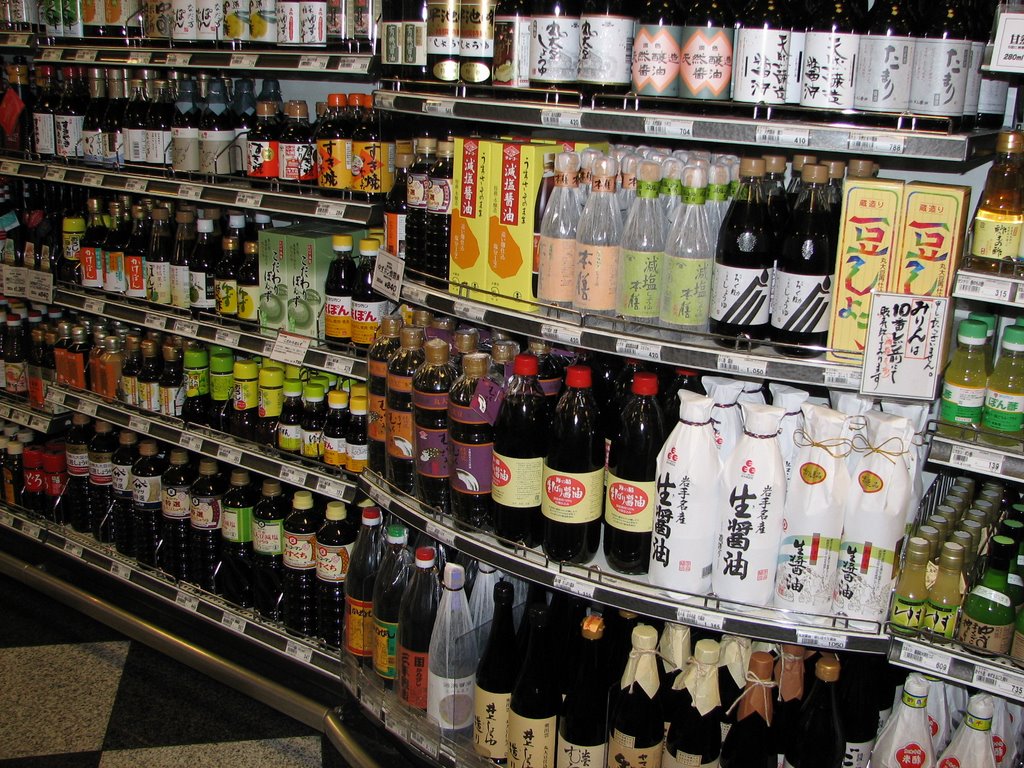
I didn’t think it was possible, but we have used almost a liter of soy sauce in our six months in Japan. What do we do with it? Well, we do not pour it over our rice, which is apparently impolite. Soy sauce is for dipping purposes only in Japan, we have been told. So, we dip our take-out sushi in it. We use it as part of a marinade for salmon or chicken, or as part of a dressing for an Asian cole slaw.

At the time of purchase, I never imagined we’d use so much soy sauce, since we only needed a small amount to go with our take-out food. But in our first trip to a Japanese grocery store, we were lost in a sea of one-liter bottles (large for soy sauce by American standards!) full of brown liquids with only slightly varying labels. After several moments of hesitation, we randomly grabbed one of the bottles.

Brian was prepared to take it home and be surprised. But as we checked out, I sheepishly asked the cashier, “Soy sauce?” as if surely she must know those English words? She got very nervous, gestured she’d be back, and ran to get another lady who spoke a little English. When they returned, she said, “No soy sauce.” So I hurried behind her to find out where they kept the soy sauce and how to identify it by the label.

I guess deep down I must have known we’d need more sometime in our three years here! And in retrospect, it makes sense that among all those brown one-liter bottles, the soy sauce was the only one with the English words “All Purpose Seasoning” on the label! Even we’ve found many ways to use it!

Monday, January 01, 2007

The Bare Minimum: Words You Should Learn in Japanese
Well, I've done it. I've learned Japanese. You might be thinking, "How did she do it?" And "in such a short time!"

But you can do it, too! It's easier than you think. After 6 months here, I am convinced you can get by in any language knowing the seven (or eight) words listed below.

Don't get me wrong--if you only learn these words, I'm not saying you'll understand everything and get the most out of your experience. Nor will these words be enough when you are lost and need to ask for directions or what's on a menu in a restaurant. But you'll be able to be polite on a very cursory level and fake it as long as you keep moving through crowds!

If you're like me, "I'm sorry" will probably be the most frequently used phrase. It can be used if you accidentally bump into someone. It can be used if your child is screaming and you feel badly for someone sitting next to you on the train. It can be used if your dog veers in front of someone trying to walk by you. And, along with a smile and a shake of your head, it can be used if you understand none of the words someone just spoke to you!

So, start learning these and you'll be ready for a visit to see us soon! (And don't worry, the airport has many signs in English and we'll pick you up there.)

Good Morning (used until about 10AM)
"Ohio-go-zai-mas"

Hello (from about 10AM and in afternoon only)
"Konnichiwa"

Good evening (after sunset)
"Kombanwa"

Goodbye
"Sayonara"

Excuse me
"Sumimasen"

I'm sorry
"Gomen nasai"

Thank you
"Arigato"

Kawaii, ne? (Japanese ladies like to see blond babies!)
"Cute, isn't she?"

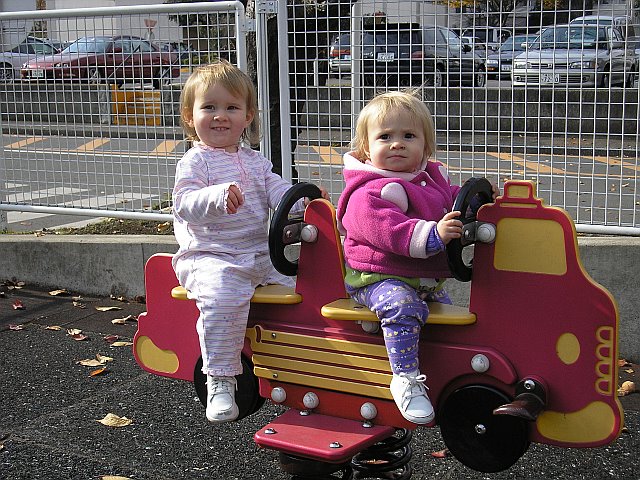
Sydney (right) with her friend Violet