 Today I took Sydney to the hair salon to get a haircut. This is the 3rd cut she's had, but today was the 2nd time I took her to the salon. Why is the 2nd trip to the salon a momentous occasion? The first time, I was too busy feeding her mini M&M's one after the other to get her to sit still, I missed my kodak moment! We were only in the salon a total of 10 minutes anyway. This time, the promise of M&M's afterward was enough to keep her still. So, I was able to snap the photo even while holding Miranda. What a cutie!
Wednesday, February 27, 2008
Sydney's 2nd (3rd) Haircut
 Today I took Sydney to the hair salon to get a haircut. This is the 3rd cut she's had, but today was the 2nd time I took her to the salon. Why is the 2nd trip to the salon a momentous occasion? The first time, I was too busy feeding her mini M&M's one after the other to get her to sit still, I missed my kodak moment! We were only in the salon a total of 10 minutes anyway. This time, the promise of M&M's afterward was enough to keep her still. So, I was able to snap the photo even while holding Miranda. What a cutie!
Today I took Sydney to the hair salon to get a haircut. This is the 3rd cut she's had, but today was the 2nd time I took her to the salon. Why is the 2nd trip to the salon a momentous occasion? The first time, I was too busy feeding her mini M&M's one after the other to get her to sit still, I missed my kodak moment! We were only in the salon a total of 10 minutes anyway. This time, the promise of M&M's afterward was enough to keep her still. So, I was able to snap the photo even while holding Miranda. What a cutie!
Tuesday, February 26, 2008
My Search For "The One"
Our "American" Scenario


It seems like I've spent years searching for "the one." I've asked all my friends for their advice. I've searched online. This may seem shocking--it was to Brian--I've even tried about six different ones (some borrowed, some bought) all at the same time...only to find "the one" does not exist!
However, this one (our "American scenario" below ) comes close. Yes, we're talking strollers (not men). But as much as I talked about making a decision about a double stroller, you'd think it was as important as finding my soul mate. (Which, BTW, wasn't half as hard. When it's right, it's right!)
I can't say I found the Joovy Ultralight myself, since I know several people who have it. But I weighed all the options (and I mean all) and finally decided this one would save me a lot of time and trouble. Sydney likes sitting on her seat and even asks to wear the seatbelt, I'll admit, because one time I dumped her out at my feet when she didn't have it on and we lurched forward. Miranda's as happy as can be in her car seat looking at me, but I'm looking forward to the less bulky day she can sit up enough to ride around in the front seat without her car seat.
So, this is "the one"...if we lived in the States. But we sort of live "in America" when on base and then, when off base, in Japan, which is very crowded especially when taking public transportation. So, a step up from an umbrella stroller, my Combi maneuvers well through crowds, has a sun shade and is extremely lightweight should we need to haul it up and down subway steps.
So, there is not one. There are in fact two perfect strollers for our mobile family.
Our "American" Scenario

Our "Japanese" Scenerio

Sunday, February 17, 2008
Japanese Calligraphy or Shodo:
And Trivia Contest #4
 Friday I had the opportunity to try my hand at Japanese calligraphy, or shodo. Don't look at Miranda napping and think it was boring; it was a fun experience! Especially since it is the Japanese way to be polite and "pump people up," so many Japanese ladies continually told me my art was really good! It is also the Japanese way to be humble and deny being any good, so I guess it was fitting when I blushed with sincerity.

Anyway, shodo is the art of writing these characters with a brush, ink and a focused mind. I'm not sure if my mind was "through the paper," as it was supposed to be. But I think I look like I'm relaxed and concentrating on this as much as a mother of two small children is able, particularly since I'm holding one of them for most of the lesson. But to attempt the symbol for "harmony," it seemed I had to unload Miranda; I don't know if I had time to quite reach "harmony," but I'll settle for a few minutes of "peace" any day.
And Trivia Contest #4
 Friday I had the opportunity to try my hand at Japanese calligraphy, or shodo. Don't look at Miranda napping and think it was boring; it was a fun experience! Especially since it is the Japanese way to be polite and "pump people up," so many Japanese ladies continually told me my art was really good! It is also the Japanese way to be humble and deny being any good, so I guess it was fitting when I blushed with sincerity.
Japanese calligraphy originated in China. Kanji, the pictoral symbols used in Japanese calligraphy originally developed from hieroglyphics. It is very interesting to see how some of these symbols are indeed pictoral representations of their meanings. For example, the symbol for mountain looks like a mountain. But some of the symbols look nothing like their meaning. This is because katakana and hiragana are also used in Japanese and were formed from changing kanji.
So, here's a trivia contest--that I venture to say--no one can win (the first three contests were too easy): what is the meaning of the symbol I am crafting in the photo above? The prize will be your choice: a coveted Tanuki or a supply of seasonal KitKats for a year.

So, here's a trivia contest--that I venture to say--no one can win (the first three contests were too easy): what is the meaning of the symbol I am crafting in the photo above? The prize will be your choice: a coveted Tanuki or a supply of seasonal KitKats for a year.


Anyway, shodo is the art of writing these characters with a brush, ink and a focused mind. I'm not sure if my mind was "through the paper," as it was supposed to be. But I think I look like I'm relaxed and concentrating on this as much as a mother of two small children is able, particularly since I'm holding one of them for most of the lesson. But to attempt the symbol for "harmony," it seemed I had to unload Miranda; I don't know if I had time to quite reach "harmony," but I'll settle for a few minutes of "peace" any day.
Thursday, February 14, 2008
KitKat
Most times in Japan, as foreigners, all we have to go on is pure observation. Actually, our observations are even less revealing than one might think since we don't read Japanese!
 Nevertheless, one of my favorite places to wander around gleaning Japanese culture is the grocery store. Even though I can't read Japanese, I do know my way around the produce section--not only because I'm a dietitian, but also because most fruits and vegetables are identifiable without knowing how to read kanji! (And, BTW, if there are two or three variations of a fruit or vegetable, I always pick the most expensive one, since I've been told these are most likely to be Japanese and not Chinese.)
But identifying most any other product for the first time is like craps shooting. For example, when I bought miso, there were about 20 different products on the shelf and after several minutes of "pure observation," I just closed my eyes and picked one. (Luckily, miso or fermented soybean paste, is very salty and it goes far and keeps forever, so I haven't needed to buy more.) You might remember I had a similar experience buying soy sauce for the first time.
 Well, a random observation we've made in Japan is that KitKat candy is popular. Every few months there seems to be one or two new seasonal flavors on the candy shelf. I first noticed key lime in the summer, hazelnut and caramel in the fall, and cherry blossom and strawberry recently. In fact, KitKats are one of the few candies that you can buy in bulk (like a bag of Halloween candy) in Japan.
I recently found out why these things are so popular; the Japanese word kito means “sure” and katsu means “win.” Hence, KitKat (kito katsu) could be translated as “sure win” or “certain victory.” That's why Japanese parents tuck KitKat bars into their children’s lunch boxes to wish them good luck on their exams. I guess I'd buy a whole bag, too, if I thought they were good luck.
Most times in Japan, as foreigners, all we have to go on is pure observation. Actually, our observations are even less revealing than one might think since we don't read Japanese!
 Nevertheless, one of my favorite places to wander around gleaning Japanese culture is the grocery store. Even though I can't read Japanese, I do know my way around the produce section--not only because I'm a dietitian, but also because most fruits and vegetables are identifiable without knowing how to read kanji! (And, BTW, if there are two or three variations of a fruit or vegetable, I always pick the most expensive one, since I've been told these are most likely to be Japanese and not Chinese.)
But identifying most any other product for the first time is like craps shooting. For example, when I bought miso, there were about 20 different products on the shelf and after several minutes of "pure observation," I just closed my eyes and picked one. (Luckily, miso or fermented soybean paste, is very salty and it goes far and keeps forever, so I haven't needed to buy more.) You might remember I had a similar experience buying soy sauce for the first time.
 Well, a random observation we've made in Japan is that KitKat candy is popular. Every few months there seems to be one or two new seasonal flavors on the candy shelf. I first noticed key lime in the summer, hazelnut and caramel in the fall, and cherry blossom and strawberry recently. In fact, KitKats are one of the few candies that you can buy in bulk (like a bag of Halloween candy) in Japan.
I recently found out why these things are so popular; the Japanese word kito means “sure” and katsu means “win.” Hence, KitKat (kito katsu) could be translated as “sure win” or “certain victory.” That's why Japanese parents tuck KitKat bars into their children’s lunch boxes to wish them good luck on their exams. I guess I'd buy a whole bag, too, if I thought they were good luck.
Monday, February 11, 2008
A Japanese Experience at The New Sanno
Half a year ago, I decided we should book a Japanese suite at The New Sanno. This weekend we finally got to see what that entails. There are several factors which make a suite "Japanese." Here are a few of them:


1. A genkan, or entryway, where one leaves his/her shoes. (It is important not to walk in this area without shoes on, so as to not bring dirt into the home or suite.)


4. Tatami, or woven straw mats as flooring. And a tokonoma, or small alcove showcasing usually a scroll of calligraphy and Ikebana, a Japanese floral arrangement.
5. A Japanese garden view, with sliding shoji (or rice paper screens) framing the large window.

6. A zataku, or low seated table. Usually with zabuton, or floor pillows for seating, not always with the chairs seen here.

Half a year ago, I decided we should book a Japanese suite at The New Sanno. This weekend we finally got to see what that entails. There are several factors which make a suite "Japanese." Here are a few of them:


1. A genkan, or entryway, where one leaves his/her shoes. (It is important not to walk in this area without shoes on, so as to not bring dirt into the home or suite.)
2. A tea set, complete with complimentary green tea in a canister covered with washi paper. And of course a hot water pot. (Japanese tea sets usually have 5 cups, but since this suite only accommodates 3 people, there are only 3 cups.)


4. Tatami, or woven straw mats as flooring. And a tokonoma, or small alcove showcasing usually a scroll of calligraphy and Ikebana, a Japanese floral arrangement.
5. A Japanese garden view, with sliding shoji (or rice paper screens) framing the large window.

6. A zataku, or low seated table. Usually with zabuton, or floor pillows for seating, not always with the chairs seen here.

8. A deep Japanese bathtub for a clean hot soak, after first bathing in a separate shower area. (This suite had a larger bathtub, but was not traditional in that the shower area was not separate. Many Japanese inns have a shared bathroom or onsen, natural hot spring bath.)
Our experience was a good one, but hardly a "zen experience" with two children. We're just glad we made it out of there without having to replace the shoji (children aren't usually allowed in these suites) and without getting lost driving home (as we did on the way there--long story, but I've never been so happy to see Tokyo Tower)!
Sunday, February 10, 2008
The Anpanman Children's Museum

Last week, Sydney, Miranda and I ventured on the train with our friends Kathy, Kathleen, Sydney and Julia to visit the Anpanman museum in Yokohama, Japan.


Last week, Sydney, Miranda and I ventured on the train with our friends Kathy, Kathleen, Sydney and Julia to visit the Anpanman museum in Yokohama, Japan.

Anpanman is a sweet bean-filled bread-head anime character. He fights for justice, mostly against the anime villian Baikinman or "germ man." He is particularly helpful in fighting poverty, as you can imagine; whenever he comes across someone who is hungry, he lets that person eat part of his head. It is then replaced by his father, "Uncle Jam," who is obviously a baker.

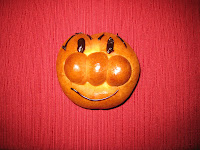
Here's the cute anpan (sweet-bean filled bread) we ate for dessert that night, thanks to Kathy! It was tasty, so we were disappointed when its head wasn't miraculously replaced after we ate it.
Click here to see a video of Anpanman in action, courtesy of You Tube (and Kathleen for finding it), in case you are interested. There are many more photos of our fun day in the photo gallery, too.
Tuesday, February 05, 2008
Snow, Snow, Snow!
 Someone recently tried to tell Brian that the last time it snowed in Yokosuka it was 1983, 25 years ago. While it certainly doesn't snow often here (our climate is like the mid-Atlantic states), I suspect that was an exaggeration. Besides, if it didn't snow often enough, why else would Japanese people need chains for their car tires?


Amid all this winter wonderland fun, I'm slightly concerned about the fact that our neighborhood hardly accumulated any snow compared to the base, which is only about 4km away from here. I have fears that since our neighborhood is built upon landfill that there is some type of unnatural thermal energy radiating from the ground. On second thought, if that were true, my house wouldn't be so cold! It must be that we're south of the base.
 Someone recently tried to tell Brian that the last time it snowed in Yokosuka it was 1983, 25 years ago. While it certainly doesn't snow often here (our climate is like the mid-Atlantic states), I suspect that was an exaggeration. Besides, if it didn't snow often enough, why else would Japanese people need chains for their car tires?
No, I am not kidding! There were several cars with chains on the tires on the road from our house to the Navy base. Note the scant snow on the street. Since Brian is from Boston, he got a good kick out of seeing that sight.

But while in the Northeast we could barely build a snowman with the dry, ice-topped snow, this wet snow appeared to form a perfect snowman! Here Frosty poses as the traffic cop.


Amid all this winter wonderland fun, I'm slightly concerned about the fact that our neighborhood hardly accumulated any snow compared to the base, which is only about 4km away from here. I have fears that since our neighborhood is built upon landfill that there is some type of unnatural thermal energy radiating from the ground. On second thought, if that were true, my house wouldn't be so cold! It must be that we're south of the base.
Tuesday, January 29, 2008
Our Jet-Setting Girls
 We're back from the States. We had a great time, although we were never in one place long enough! Japan to Virginia to North Carolina, back to Virginia, up to Boston, to NH, back to Virginia and finally home to Japan again.
You tired, too? I didn't even count Chicago and Washington, DC for our connecting flights!
 At the ripe old age of 2, Sydney has been on 21 flights, if you count all the connections. Miranda, a mere 2 months old, has already been on 8 herself! But don't let the term "jet setting"--or the photo of Sydney with her "in flight entertainment"--conjure up images of us flying in style. Forget first class or business class. With two young children, we were relegated to the last row of the aircraft on more than one occasion. Coincidence? I think not!
But no one had any idea how good they'd turn out to be, so I guess I can't blame the airline people for assuming the worst. We did and were pleasantly surprised. Good news, since our next trip (to Hawaii) was already booked before we took this one!
Anyway, check out our photos in the Photo Gallery.
 We're back from the States. We had a great time, although we were never in one place long enough! Japan to Virginia to North Carolina, back to Virginia, up to Boston, to NH, back to Virginia and finally home to Japan again.
You tired, too? I didn't even count Chicago and Washington, DC for our connecting flights!
 At the ripe old age of 2, Sydney has been on 21 flights, if you count all the connections. Miranda, a mere 2 months old, has already been on 8 herself! But don't let the term "jet setting"--or the photo of Sydney with her "in flight entertainment"--conjure up images of us flying in style. Forget first class or business class. With two young children, we were relegated to the last row of the aircraft on more than one occasion. Coincidence? I think not!
But no one had any idea how good they'd turn out to be, so I guess I can't blame the airline people for assuming the worst. We did and were pleasantly surprised. Good news, since our next trip (to Hawaii) was already booked before we took this one!
Anyway, check out our photos in the Photo Gallery.
Monday, January 07, 2008
Things You'd Only Say in Japan...
Here is a short collection of phrases I've found myself muttering at one point or another in the past year and a half. As the words crossed my lips, I noted to myself that I would not be needing to say these if I were not living in Japan! (My friends in Japan, feel free to add any you might have said in the comments section!)
"Which way do I stand to pee?"
(In reference to a Japanese women's pubic toilet--basically a hole in the ground.)
"Wow, it's 41 degrees inside the house!"
(In winter without room heaters on overnight.)
"Did you notice I turned up the heated toilet seat?"
(At home.)
"There must be a drink machine around here somewhere."
(On a rural street.)
"If you're leaving the house in the morning without a bag of garbage or recycling to put out, you should feel like you're forgetting something!"
(To Brian, about taking the trash/recycling out every weekday.)
"Is dog poop burnable or nonburnable trash?"
(Self explanitory, no?)
Here is a short collection of phrases I've found myself muttering at one point or another in the past year and a half. As the words crossed my lips, I noted to myself that I would not be needing to say these if I were not living in Japan! (My friends in Japan, feel free to add any you might have said in the comments section!)
"Which way do I stand to pee?"
(In reference to a Japanese women's pubic toilet--basically a hole in the ground.)
"Wow, it's 41 degrees inside the house!"
(In winter without room heaters on overnight.)
"Did you notice I turned up the heated toilet seat?"
(At home.)
"There must be a drink machine around here somewhere."
(On a rural street.)
"If you're leaving the house in the morning without a bag of garbage or recycling to put out, you should feel like you're forgetting something!"
(To Brian, about taking the trash/recycling out every weekday.)
"Is dog poop burnable or nonburnable trash?"
(Self explanitory, no?)
Tuesday, January 01, 2008
2008: The Year of the Mouse
 New Year's is the most popular holiday in Japan. But it's not a one-day event as in the States, it's usually several days of celebrations. And it's not complete without the appropriate Chinese zodiac representation, which you see all over stores this time of year. This year happens to be the year of the mouse, so here we have three mice rolls, for example. Why three? One for Sydney and her two friends.
Why mouse instead of rat? I have a theory. It may be fact, I have no idea. I believe the Chinese zodiac calls 2008 the year of the rat. But rats are so "inner city"; mice are much more "suburban." So, I think the genteel Japanese prefer to refer to 2008 as the year of the mouse, since it sounds much more socially acceptable and kawaii, ne? I digress...
 Beginning the day after Christmas and ending January 7th, traditional decorations called kodamatsu are placed in pairs, representing male and female, outside the front gate of a home to welcome ancesteral spirits. They are typically made of pine, bamboo and sometimes ume (plum) branches, representing longevity, prosperity and steadfastness, respectively. Sometimes there are three bamboo shoots, representing heaven, humanity and earth. Sometimes shimekazari, a twisted straw rope with fern leaves, an orange and other items of good omen, are placed outside the home.
 New Year's foods usually include mochi, which is a very chewy and sticky rice cake made from sticky rice that is pounded repeatedly until it forms a cake. It is usually prepared prior to New Year's Day in mochi-pounding ceremonies and then eaten on New Year's Day or early in January. Because of its very sticky texture, elderly or very young people have been known to actually die from choking on mochi. The day after New Year's Day a mochi-related death toll is often reported in newspapers. I think it's obviously only considered auspicious if you survive eating it. And we did! Here's our mochi all puffed up as it toasted in our Japanese toaster/microwave/grill oven.
 New Year's is the most popular holiday in Japan. But it's not a one-day event as in the States, it's usually several days of celebrations. And it's not complete without the appropriate Chinese zodiac representation, which you see all over stores this time of year. This year happens to be the year of the mouse, so here we have three mice rolls, for example. Why three? One for Sydney and her two friends.
Why mouse instead of rat? I have a theory. It may be fact, I have no idea. I believe the Chinese zodiac calls 2008 the year of the rat. But rats are so "inner city"; mice are much more "suburban." So, I think the genteel Japanese prefer to refer to 2008 as the year of the mouse, since it sounds much more socially acceptable and kawaii, ne? I digress...
Speaking of dirty rodents, in the days preceeding the New Year, there is also a preparation period of deep cleaning within Japanese homes to rid the home of dirt from the past year and approach the fresh New Year. I could show you a picture of our house's "dirt from the past year" (and a half, actually), since I didn't participate in this cleaning ritual. But I won't.
 Beginning the day after Christmas and ending January 7th, traditional decorations called kodamatsu are placed in pairs, representing male and female, outside the front gate of a home to welcome ancesteral spirits. They are typically made of pine, bamboo and sometimes ume (plum) branches, representing longevity, prosperity and steadfastness, respectively. Sometimes there are three bamboo shoots, representing heaven, humanity and earth. Sometimes shimekazari, a twisted straw rope with fern leaves, an orange and other items of good omen, are placed outside the home.
 New Year's foods usually include mochi, which is a very chewy and sticky rice cake made from sticky rice that is pounded repeatedly until it forms a cake. It is usually prepared prior to New Year's Day in mochi-pounding ceremonies and then eaten on New Year's Day or early in January. Because of its very sticky texture, elderly or very young people have been known to actually die from choking on mochi. The day after New Year's Day a mochi-related death toll is often reported in newspapers. I think it's obviously only considered auspicious if you survive eating it. And we did! Here's our mochi all puffed up as it toasted in our Japanese toaster/microwave/grill oven.
Of course, other (safer) traditional foods are eaten and referred to as osechi. These are usually sweet, sour or dried foods, which didn't require refrigeration back in the day since stores were closed on New Year's Day (as many still are today.)
To ring in the new year, many Japanese people visit shrines on New Year's Eve through the night to hear the 108 temple chimes at midnight, which are believed to release people from the 108 wordly sins. Sometimes people visit shrines on New Year's Day to experience the first visit of the year, since "firsts" are often considered important and auspicious.
Japanese people also traditionally send New Year's post cards, called nengajo, which are guaranteed by the Post Office to arrive exactly on New Year's Day if sent by the deadline. These cards can be preprinted cards, or hand-made or stamped. But most cards have the Chinese zodiac sign of the New Year as their design. (Interestingly, it is customary not to send these postcards when one has had a death in the family during the year. In this case, a simple postcard is sent instead to inform friends and relatives that they should not send joyful New Year's cards, in order to show respect for the deceased.)
Also on New Year's Day, people give special pocket money allowances to their children, nephews and nieces called Otoshidama, which is a Chinese custom. It is handed out in small decorated envelopes called pochibukuro.
Thought you'd enjoy hearing about these New Year's customs!
Thought you'd enjoy hearing about these New Year's customs!
Happy New Year!
あけましておめでとうございます!
Akemashite omedeto gozaimasu!
Subscribe to:
Comments (Atom)

